Bold.org Tips Experience
At Bold.org, donors are the core of the platform, driving engagement and meaningful outcomes for students. This impact is enabled by a highly personalized, high-touch donor service model — effective by design, but difficult to scale sustainably.
Date
Fall 2025
Team
2 Designers / CEO, VP of Donors, Donor team, Engineering
My Role
Product Design, Product Strategy, Revenue Design, Branding
The Problem & Context
Bold.org grew rapidly by keeping the donor experience fee-free and frictionless, with a strict promise that 100% of all donations go to students.
This model helped onboard thousands of donors fast, but left donor operations dependent on other revenue sources. The challenge was to create donor-product independence without breaking the frictionless experience.
As the Donor Team supports donors at every step, some Donors felt grateful and asked how can they support Bold.org operations. This was the beginning of introducing optional tips in the product.
Early Signals & Course Correction
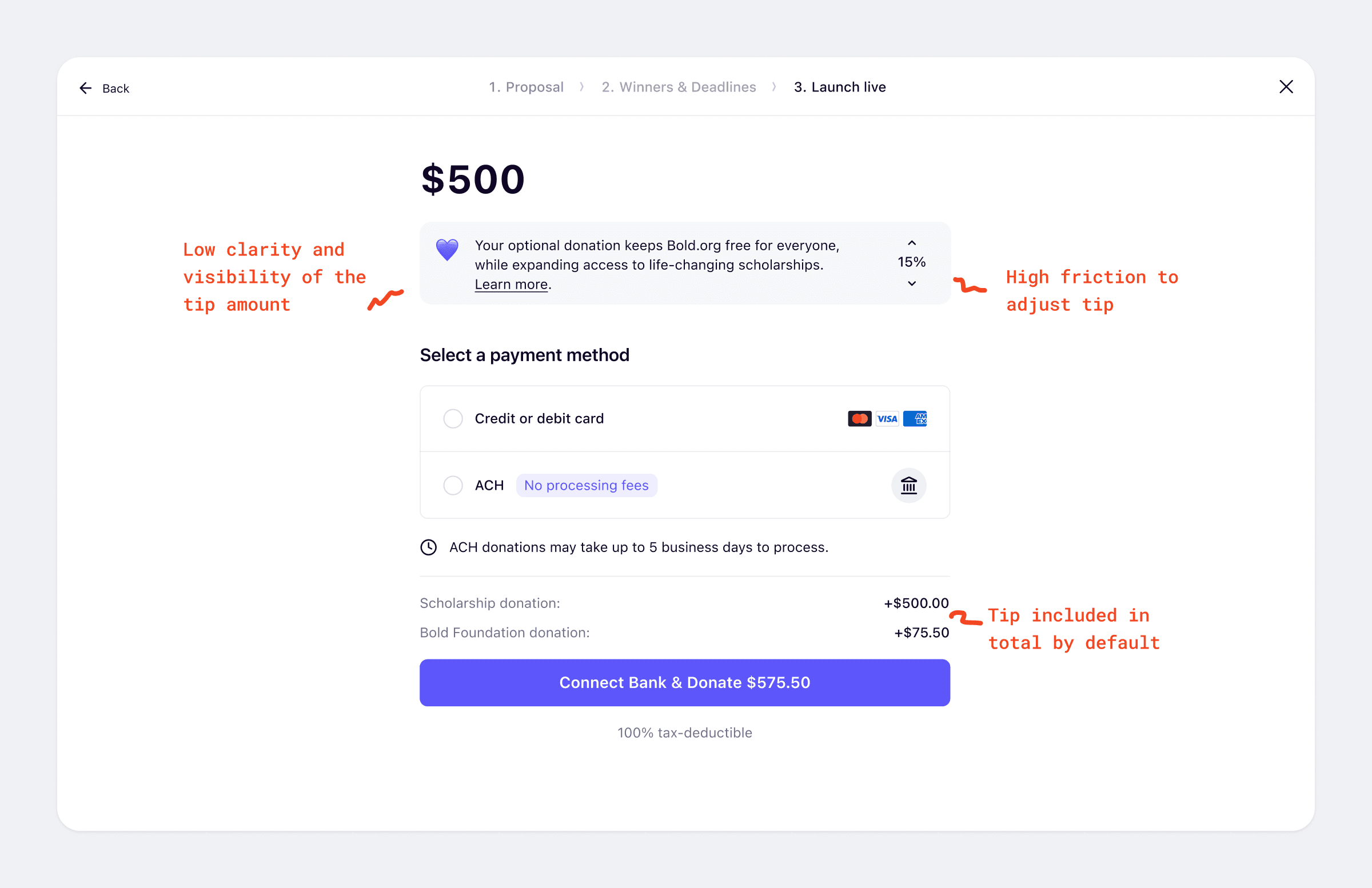
Early user interviews revealed clear warning signs. Initial iterations, influenced by a more aggressive monetization direction, suffered from insufficient transparency, ambiguous placement, and a perception of tipping as a hidden or required fee. Even in small-scale testing, donors reacted negatively to what they perceived as a hidden fee. Many actively set the tip value to $0, signaling discomfort and leaving the experience with reduced confidence.
To ground the next direction, we:
Ran targeted user interviews to understand donor expectations, mental models, and sensitivity around money
Synced closely with the Donor Team to surface recurring questions, objections, and pain points observed in real donor conversations
Mapped end-to-end donor workflows to identify where tipping could appear naturally and where it would feel intrusive
This work made it clear that the issue was not how tipping was designed, but where and when it appeared — and whether donors felt fully informed and in control.
This became a turning point. We reframed the question from “how do we increase tipping?” to “how do we design a system donors feel good about participating in?”
Strategy: prioritize trust to improve monetization
I reframed tipping as a revenue mechanism designed for scale, constrained by trust — not as a fee, and not as soft participation.
Hypothesis
If tipping is fully transparent, clearly optional, and presented only at moments of genuine donor gratitude, donors will opt in voluntarily — increasing the overall volume of tips without eroding trust..
We explicitly ruled out:
Default-on tipping
Guilt-based or emotionally manipulative language
Fine print or unclear explanations
Product Flows & Experience
The tipping system was implemented across multiple high-impact donor journeys. Rather than treating tipping as a single UI moment, we designed it as a cross-flow product capability, adapting behavior, timing, and disclosure based on donor intent.
Scholarship Proposal Flow
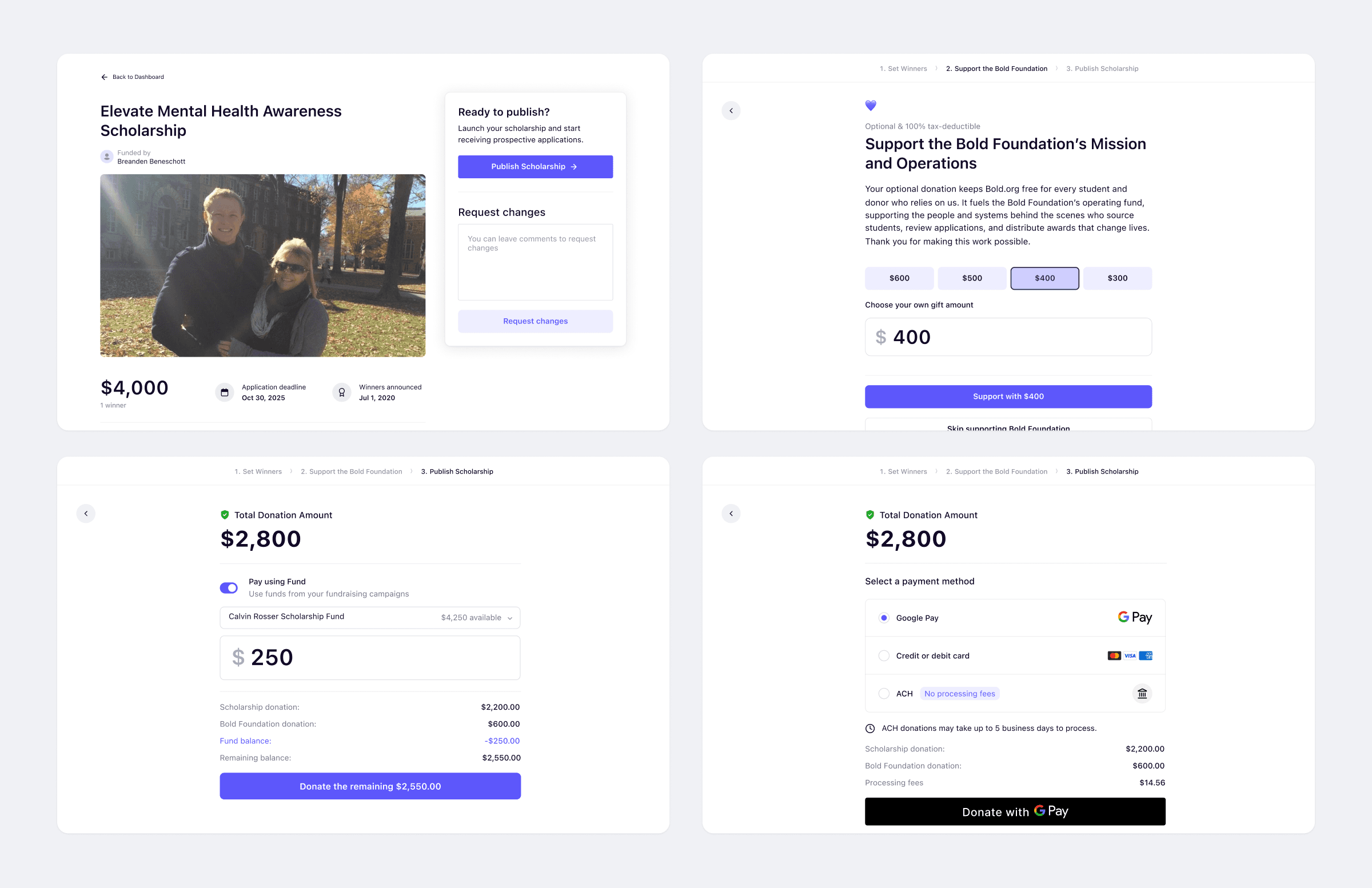
This is the first time donors encounter tipping, they don't have context for the concept and expect that the platform fees-free and 100% of their scholarship goes to the winner.
So we designed tipping as a separate, full-screen step to maximize transparency around what the tip is, what it supports, and how it differs from scholarship funds going directly to students.
The experience explicitly reinforced optionality at multiple levels:
Clear messaging that tipping is optional and does not affect scholarship outcomes
Transparent explanation of how the funds are used
A highly visible secondary CTA to skip supporting the Bold Foundation entirely
Contribution to a Scholarship from a Fundraiser
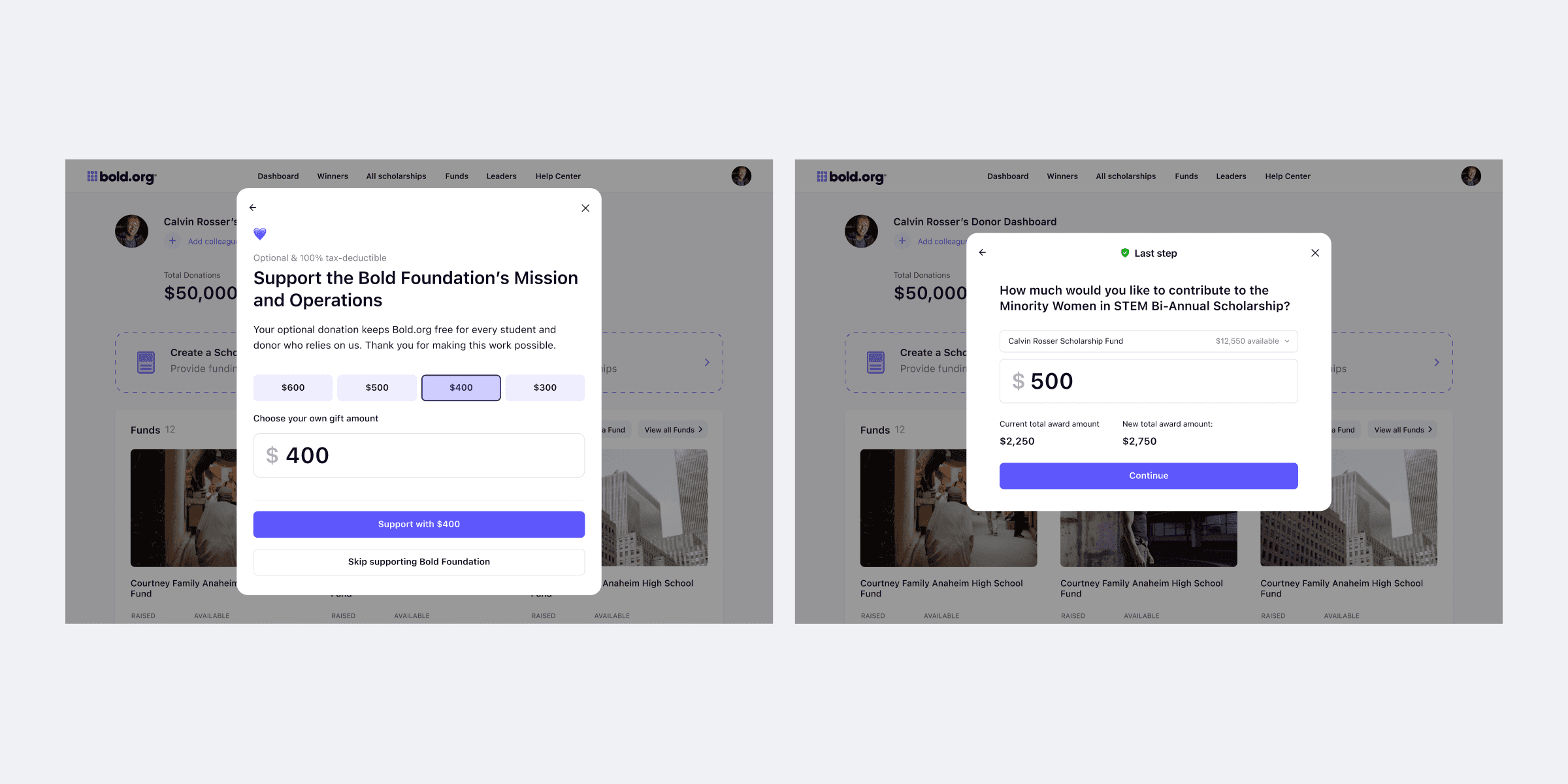
Donors have millions raised via fundraisers and can use them to fund any scholarship on Bold.org. We treated this as a bridge moment between external contributions and in-platform donor intent. Tipping was presented with clearer context than in community contribution flows, but without the full educational step used during initial scholarship setup.
Tipping was therefore presented with more context than in community contribution flows, but as the last optional step.
The design focused on:
Preserving clarity between various data shown and money movements.
Reinforcing that 100% of raised funds still go to students
Offering tipping as an optional, clearly separated action
Awarding Winners Flow
This moment represented peak donor satisfaction and emotional payoff. The experience was designed to:
Align with donor gratitude rather than obligation
Reinforce impact already achieved
Offer tipping as a voluntary follow-up, never as a requirement
Contribution Flow
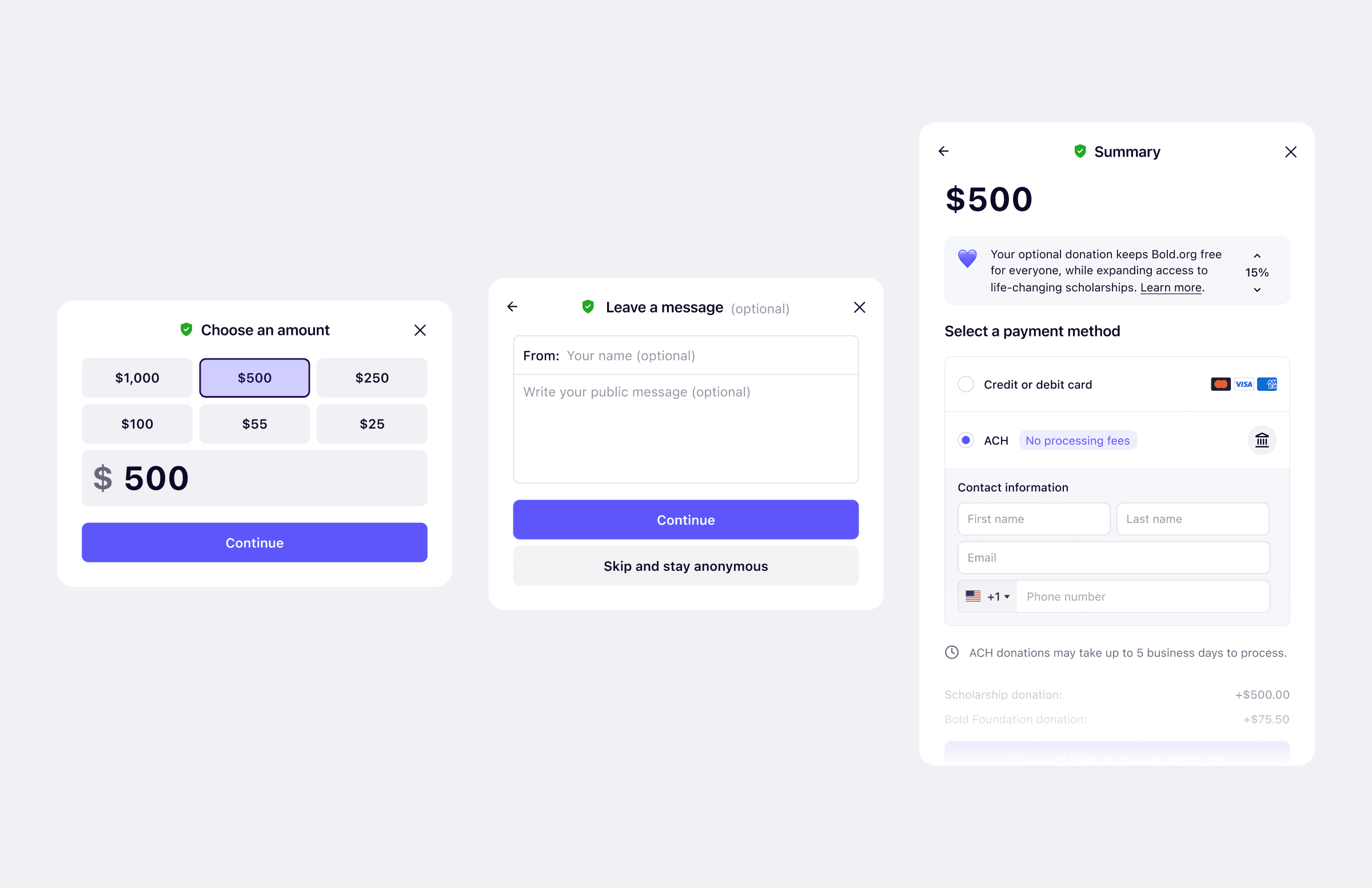
In this flow, community members (not Bold.org donors) contribute directly to a shared fundraiser.
After testing, we deliberately chose a different approach from in-platform donor experiences. This is a distinct user group with a simple, one-time goal: completing a contribution. For them, reducing decision friction proved more effective than enforcing clear separation between donation and tipping.
Quantitative testing showed that this approach reduced contribution drop-off while maintaining meaningful tip volume.
Outcomes & Impact
The final solution exceeded expectations across both trust and business outcomes:
Optional tipping now generates 20–25% of Bold.org’s total revenue
The donor product is able to fund its own operational costs, reducing dependency on other revenue sources
Donors who tip are significantly more likely to create additional scholarships
Donor engagement deepened, with no increase in complaints or mistrust signals
Most importantly, Bold.org remained a safe and joyful place for donors to make a real, meaningful impact at scale.